Bluegrass Cellular, a regional carrier centered in Kentucky, has announced that the Motorola Milestone X is "coming soon" to their network. The phone is more or less a Droid X without the Droid branding, and continues the Milestone branding that Motorola has used for their Droid phones when offering them to carriers not named Verizon. The phone is the latest addition to a robust Android lineup from Bluegrass that includes the original Milestone (OG Droid) and the HTC-made Desire and Wildfire. For some reason the Milestone X is listed as having Android 2.1 Eclair as opposed to Froyo, which has long since rolled out for the Droid X.
The launch of the Milestone X opens the possibility for the phone to make its way overseas or to grace other regional U.S. carriers like Cellular South. [Bluegrass Cellular] Thanks to Nathan for the tip!
Remember that unannounced HTC Android phone that was spotted on a Taipei subway? Looks like it's appeared again, with a new pic being sent to Gizmodo. It's reportedly codenamed "Saga." Not a whole lot more to say about it -- capacitive buttons, front-facing camera, and the usual HTC design cues. But we're willing to bet it'll have a few tricks up its sleeve. Might we see it in two weeks at Mobile World Congress? It's looking fairly likely. [Gizmodo]
Sure, the dual-core LG Optimus 2X is all the rage right now (be sure to check out our hands-on, benchmarks and gaming tests), but another high-end LG phone is starting to make the rounds. Phandroid got slipped this pic of what's being called the Optimus 3D. It very much looks like the Optimus 2X from the front, but the bottom bezel and earpiece are slightly different.
As far as that whole "3D" thing goes, no telling on that yet (and we're still not entirely sold on the idea sight unseen). But the screen supposedly is larger than 4 inches, has a dual-core processor (no surprise there) and "multi-channel RAM" (is that new?)
So, yeah, we'll see about this whole 3D thing. And by "we'll see," we mean we'll be at LG's event at Mobile World Congress in a couple weeks, and we'll get this thing figured out. [Phandroid]
If you're on Nextel and have a hankering for some a physical QWERTY keyboard, it looks like relief might one day be in sight. The Motorola i1q (a follow-up to the also-rugged Motorola i1 on Nextel) appears to be a fairly rugged device, with full physical buttons -- including menu, home, back and call/end. It's said to be rocking Android 2.1 on a slow processor -- no great surprise -- but "manufacturing is quite robust."
No word about when we may see this guy drop, but we could see a lot of you in the field rocking this guy. There's one more pic after the break. [via Grupoandroid] Thanks, Andres!
LG's promotional strategy for the G-Slate seems to be to keep officially mum about the device, while letting random pseudo-celebrities tease it out in brief glimpses. A week ago, K-Pop artist Seungri gave us our first sighting of the dual-camera array on the back of the G-Slate, which has today made its triumphant return to YouTube, courtesy of one MysteryGuitarMan. The rear of the device here doesn't look identical to the one in Seungri's video, however the metallic strip separating the cams and its "with Google" branding look nearly identical to what LG has on the back of its Optimus 2X Android smartphone. We're also seeing a single LED flash for the first time, there are a couple of unidentified connectors at the bottom, at least one of them likely to assist docking in landscape mode, and we do get to see the tablet in profile for an idea of how thin it is. Video after the break.
It's been an interesting few weeks of rumored Dell Streak 7 prices, but as promised, T-Mobile's setting the record straight with some official dollar figures. Yep, that predicted $330 price was indeed pretty far off -- turns out, T-Mobile will be offering the 7-inch, Android 2.2 tablet for just $200 (okay, $199.99 to be exact) on contract starting this Wednesday, February 2nd. Of course, you'll have to sign a two-year contract to get that sweet deal as well as send in a $50 mail-in rebate. Those looking for a bit more freedom can snatch up the NVIDIA Tegra 2-powered, T-Mobile HSPA+ slate for 450 bucks, which actually seems like a pretty sweet deal to us considering the Samsung Galaxy Tab is still about $500 off contract and $300 with two years of service. Sure, the Galaxy Tab has a few more things going for it, including a higher resolution display and bigger battery, but you'll just have to wait for our full review of the Streak 7 to find out if Dell's got a killer "4G" Android tablet hitting shelves later this week.
One day somebody will write a book called "The rise and rise of Android" and this moment will be highlighted in bold. Canalys' latest smartphone sales figures show that Android phone makers managed to shift a cool 33.3 million handsets in the last quarter -- more than any other smartphone platform out there, including the previous leader, Symbian, which sold 31 million units. That's a mighty leap from the 20.3 million Android devices the stats agency estimates were sold in Q3 2010. Symbian itself grew from 29.9m in Q3 to 31m in Q4, but Android's pace of expansion has been so rapid as to make that irrelevant.
Update: NPD's numbers are in as well, indicating that Google now has a 53 percent share in the US market, while Windows Phone 7 has managed to nab only two percent so far.
The HTC Thunderbolt may have been officially announced way back at CES, but there's still quite a bit we don't know about the phone -- namely, a price or a release date. We now at least have what looks to be a fairly solid hint of the latter, however, courtesy of the above shot of a Best Buy inventory screen that lists an in stock date of February 14th. You'll note that the screen doesn't actually mention the HTC Thunderbolt anywhere, but some sleuthing by the folks at Android Central reveals that the product code matches one found on a Thunderbolt box that turned up in a recent hands-on video. Joining that rumor is a separate one from Droid Life, which has obtained some supposedly authentic Verizon materials that suggest the Thunderbolt won't be shipping with mobile hotspot functionality enabled at launch, and that Skype video chat won't be enabled initially either. No word on a reason for the delay (if there actually is one), but both features will seemingly be enabled at some point, and there will apparently be a placeholder icon in the case of Skype that will display a "coming soon" message if it's launched
Enspert blindsided us at CES 2011 with a pair of quality Android tablets, and here's another surprise -- next month, the company's Identity Tab E201 will apparently ship 100% Google-certified. Importer Dynamism is taking preorders on February 1st for the 7-inch Android 2.2 tablet, which comes with both Gmail and Android Market on board, though admittedly for a somewhat larger outlay than we originally heard. $350 is what you'll pay for the 800 x 480 slate, which sports a 1GHz Hummingbird processor and PowerVR SGX540 graphics, 8GB storage and 512MB RAM, 802.11 b/g/n WiFi, Bluetooth 2.1, a full compliment of sensors and an SD card slot. Just a month ago we'd have called this quite the deal, but come February 1st you may want to wait -- after all, Google's busy bees may show off the fruits of their labors the very next day.
Can't wait until February 2nd to see more of Android 3.0 in action? That's not a problem, as today we've got a whole 129 seconds of video showing Google's latest mobile software doing its thing on the Nook Color. The OS was ported to B&N's tablet on Friday, when we were promised further work would be taking place over the weekend to enable hardware acceleration of the GUI, and what do you know, that goal has been achieved with plenty of Sunday to spare! Most core functionality is still not available, but the delicious Honeycomb interface is very much in effect. Jump past the break for the eye candy feast. [Thanks, Jules]
We've seen a number of rumored launch dates come and go for the HTC ThunderBolt -- the upcoming LTE Android smartphone on Verizon. But rumor after rumor has offered little in the way of proof. But we now have some evidence that appears to connect a few dots -- dots that we've been discussing in the Android Central Forums for a day or so now. Check this out:
We were sent the screen shot you see above earlier this week. Note that it's a Verizon device, with an in-stock date of Feb. 14 (1). Now note that the model is listed as BBY60LD (2). Best Buy does that so we can't (easily) know what device is listed ahead of time. That doesn't tell us much, now does it? But don't worry about it. It's a red herring.
Now look at the number we've circled at the top left (3) -- 044476816574 -- With us so far?
Later Friday, a video hands-on of the Thunderbolt appeared on YouTube, purportedly made by someone at HTC. The video has since been removed, but not before Android Central Forums member paulmike3 noticed that number -- 44476816574 -- on the proof of purchase attached to the box from which the ThunderBolt was pulled. It's grainy. It's blurry. But it's definitely there. And it's more than a coincidence.
So you've got the number on the Best Buy leak. And you've got it on the ThunderBolt box proof of purchase. We've connected some major dots here, and it indeed looks as if Best Buy plans to have the HTC ThunderBolt in stock on Feb. 14. Happy Valentine's Day.
Some questions still remain. When will it be available on Verizon? (Feb. 11 has been rumored in the forums.) And is that Best Buy date real, or another placeholder? And how much is the phone going to cost? Big questions, all. And if you've got the answer, you know where to find us. Thanks, Paul, and Fire Dude!
While nobody is quite sure why (none of us, anyway), the Honeycomb SDK preview seems to have gone AWOL for most everyone looking for it. We started to get tips and questions Saturday evening, then some chatter showed up about it in the Android-Developers Google group, and our friends over at Android Community noticed the same thing. At first, you could uninstall the whole SDK and reinstall it all at once as a work-around, but now even that doesn't seem to be working. Guess about what's happening all seem to center around Google's event on Feb 2, which should answer a lot of our questions about Honeycomb. Phil will be there, and all of us will be watching and we'll keep you updated as it happens. [Android-Developers; Android Community]
Not too much new here, but Sprint's giving its employees a few more instructions regarding the upcoming $10 increase to all smartphone plans. The main thing to take out of this is that if you're currently under contract, the tax "premium data add-on" won't go into effect just yet. But you will be subject to it if you:
Swap to another smartphone
Upgrade from a feature phone to a smartphone
Add a new line with a smartphone
Reactivate a smartphone
Sprint considers Android, Palm, BlackBerry and Windows Mobile to be smartphones, of course, along with its Samsung Instinct line.
Nobody likes seeing rate increases, of course. But if that's what Sprint has to do to keep the lights on, then so be it. But we'd rather Sprint swallow the pill and price its "Simply Everything" plan at $110, and not continue to artificially advertise it at $99 instead, with the "Premium data add-on" hiding the real cost. Thanks, Lovo!
A researcher at North Carolina State University is warning of an Android 2.3 security vulnerability that gives attackers access to your personal information, further proof that Gingerbread isn't all sugar and spice (to be fair, that SMS issue has since been remedied). According to Xuxian Jiang, the bug allows malicious websites to access and upload the contents of a user's microSD card, including voicemails, photos, and online banking information to a remote server. The flaw apparently resembles a similar bug in previous version of Android, thought to have been addressed with Gingerbread. However, as Jiang points out, that fix is easily bypassed. Apart from removing the microSD card, disabling JavaScript, or switching to a third-party browser, Android 2.3 users have little recourse in squashing the bug. The folks at eWeek reported that Google is working on a solution to the problem, but there's no word on when we can expect to see an update.
Videocam Illusion for Android is a camera effects application that works with the video camera on your Android phone. We've seen similar apps that manipulate still pictures, and while they're really fun and useful, Videocam Illusion takes it to the next level by adding effects on-the-fly to live video you shoot from your phone. You can shoot up to 480p (720x480) video through the app, and the free version has four filters, four effects, and two masks to choose from. You can also shoot video at 1.33x speed.
The paid version has 18 filters, 13 effects, six masks, and your choice of five different recording speeds. They both work really well, saving the video to your SD card in .mov format for easy playback on your computer. And since stock Android doesn't playback .mov files, the Videocam Illusion app includes a player to preview -- and show off -- your masterpiece. There's a video demo, some screenshots, as well as the download link for the free version after the break.
If you're an HTC EVO Shift 4G owner who has been looking for a permanent root solution, we now have some great news for you all. You no longer have to wait any more. The HTC EVO Shift 4G permanent root solution has been found and as such, has been posted for all. You will have to proceed with caution and follow the guide to a tee but everyone should be used to that by now, especially if you frequent rooting devices. Hit up the source link for more details and instructions on how to get started. You can also check out forums to discuss it further. [XDA]
You know that rebooting problem that's been plaguing the Samsung Nexus S since its launch? Sounds like Google's just about got it nipped in the bud, and a fix should ship in the next week or two. Googler Ry Guy posts as such in Google support forums:
The initial results of our tests look very promising. At this rate we will most likely be rolling out an OTA to resolve this issue within one to two weeks. We really appreciate your patience as we do our final verifications on this fix before sending it out.
Do us a favor though -- if it takes Google 15 or 16 days to get this pushed, try not to threaten anyone with a class-action lawsuit, m'kay? [Google Support Forums via Android Central Forums] Thanks, Grimmy! Edited to correct that Ry Guy and Google's Romain Guy are not the same person.
Been wondering where the Samsung Gem is headed? Wonder no more, as it's appeared on regional carrier Bluegrass Cellular for the low, low price of $59 on contract. But for our money, we'd just buy this sucker at its outright price of $205 and skip the mess of contracts. That said, you're getting an entry-level Android phone, with Android 2.1, a 3.2MP camera and 3.2-inch touchscreen, all powered by an 800MHz processor. So it'll get the job done, but likely not win any awards doing it. One more pic after the break. [Bluegrass] Thanks, @ibegary!
Samsung Continuum owners will want to be on the lookout for an update being pushed from Verizon today. Although it is not Froyo, it is a release that contains quite a few bug fixes in it so you'll want to be sure to get it installed of you're having any weird issues. In addition to all the bug fixes, you'll also be installing VCAST apps onto your device. (Grrrr.) You can download the update if it hasn't yet pushed by going to Settings > About Phone > System Update. [Verizon]
Have an AT&T Dell Streak and haven't hacked the hell out of it yet waiting for Froyo to finally arrive? Looks like we might have some good news for you, via the latest Best Buy Employee News.
You've been asking and now there's an answer! The Dell Streak will receive an over-the-air (OTA) update to Android 2.2 on Tuesday, Feb. 1. This information should help generate excitement with customers who have been asking for the update. You've been asking and now there's an answer! The Dell Streak will receive an over-the-air (OTA) update to Android 2.2 on Tuesday, Feb. 1. This information should help generate excitement with customers who have been asking for the update.
You know how it goes with OS updates -- we'll believe it when we see it. But the poor not-so-little 5-inch tablet may finally see Froyo in the U.S. next week -- and none too soon, with the Dell Streak 7 on the way. Thanks, Mr. Snuffleupagus!
Never would we have guessed that third-party wireless retailers would be aiming to launch AT&T's powerhouse Atrix 4G for just $150 on contract -- $200 or $250, sure, but not $150. Alas, just a few hours after AmazonWireless' peep show, we're seeing an alleged leaked screen shot of Costco's inventory system showing the same blockbuster price. Now, bear in mind that AT&T itself will probably sell the phone for at least $50 more -- third parties usually have a second ETF on top of the carrier's that allows them to subsidize a little more heavily -- but it's a good sign regardless.
Thought Honeycomb was just for tablets? Well, it's not! Sure, tablets might be Google's main thrust with the release, but we've been able to dig up enough evidence in the preview SDK's emulator released yesterday to suggest that these guys are still keeping their eyes on the smartphone prize.
Here's how it works: the emulator can be set to load at an arbitrary screen resolution. By default, that's WXGA, 1280 x 768 -- perfect for tablets, but obviously a wee bit large for even the biggest smartphones. Well, it turns out that setting the emulator to WVGA (like you might find on a modern mid- to high-end smartphone) triggers a moderately different shell UI that lacks most of the whiz-bang home screen stuff Google's shown on the Honeycomb tablets. In fact, the default launcher crashes out entirely, which means you need to install a replacement (Launcher Pro works nicely) just to play around.
Once you get in, it's pretty raw, but you immediately notice that the emulator's got some traces of smartphone support. Notably, the status bar reverts to a more smartphone-friendly form, albeit one with pre-Gingerbread background coloration and incorrectly-inverted font colors. The lock screen (pictured above) is back to its old form, not the webOS-esque circular lock in the Honeycomb tablet UI. The browser -- which has been completely revamped in Honeycomb -- works, though without visible tabs; Google might be thinking that they'd take up too much real estate on a screen this small.
Again, you can't glean much here, but it's interesting primarily because the emulator knows to revert to a smartphone UI layout at the lower resolution -- a possible sign that Honeycomb will be a true dual-mode, dual-purpose platform from day one. And even if it isn't, it looks like they're setting themselves up for a two-UI strategy down the road.
One of the first things that happens after a new platform emulator breaks loose is that a bunch of hackers far smarter than ourselves get hold of it, tear it apart, and port it to whatever's convenient. In the case of this week's Android 3.0 Honeycomb preview, "whatever's convenient" would be the Nook Color, which reigns as perhaps the cheapest decent-quality Android tablet money can currently buy. Naturally, xda-developers has a thread going on the subject as we speak; the current port is said to be really slow and mostly broken -- but then again, that kind of describes the current state of the emulator itself. Good news is that the developer says he plans on working on graphics acceleration to improve performance over the weekend, so with any luck, the Xoom might have some unofficial competition before too long. Follow the break for another shot.
Had enough Honeycomb this week? Perhaps -- but next week is a whole new week, and Google's got your back. Mountain View has selected Wednesday, February 2nd for an event that'll include "an in-depth look at Honeycomb, Android ecosystem news and hands-on demos," so by all accounts this seems to be more than a mere wrap-up of everything they've announced in the past few weeks. New tablets? Honeycomb for smartphones? Android 2.4? Something else entirely? We'll be there to find out, of course.
Amazon's German outlet has started listing LG's two latest and undoubtedly greatest phones: the Optimus 2X (seemingly renamed the Optimus Speed here) and the Optimus Black. Both run Android 2.2 on 4-inch screens, with the former offering a dual-core Tegra 2 processor capable of 1080p video recording and HDMI output, and the latter cranking up the display brightness to a quite unreasonable 700 nits. The Optimus Black also has one of the thinnest profiles on a smartphone of its class at 9.2mm, and will be one of the first phones to offer WiFi Direct connectivity. Intriguingly, Amazon's Optimus Speed / 2X listing also shows a brown color option for the handset, though only its black SKU is subject to a neat €50 discount bringing its price to €499, the same as the cost of the Optimus Black. We don't know when either one will drop, but you can go and reserve yourself one (or a dozen) at the links below.
We suspect the boys and girls over at AmazonWireless threw their Atrix 4G product page up early, because -- among other red flags -- the buy button doesn't work, but one important detail we can glean from it is that they seem interested in selling it for $149.99 on a new contract or $599.99 off-contract. Now, there are a couple of possibilities here; first off, since the page likely isn't supposed to be online, these prices might just be guesses or placeholders, but furthermore, keep in mind that AmazonWireless and other third-party wireless resellers typically charge less for devices on contract than carriers do, so we'd expect this to be at least $50 more directly from AT&T. Oh, and one other tidbit: searching for the phone on Amazon reveals a possible release date of February 11th, which would be even more aggressive than Moto's end-of-February guidance. Again, possibly another guess or placeholder on Amazon's part... but it's a date to keep in the back of your head nonetheless.
[Thanks, Roman]
Update: Turns out the Inspire 4G is listed, too, for $99.99 on contract or $499.99 contract-free. Thanks, Justin S.!
The software on Motorola's upcoming Atrix 4G has already been subject to some stern (and premature) scrutiny, but here's some rather more concrete information about it, courtesy of the company's own spec page for the device. As it turns out, Moto intends to launch the Atrix with some of its hardware capabilities clipped -- specifically its Tegra 2-derived power to encode 1080p content -- but will deliver them to users in an update (hopefully soon) thereafter. LG's Optimus 2X, which is built around the same dual-core chip from NVIDIA, has been spending its time before launch showing off exactly what those 1080p encoding skills can deliver -- both with video recording and through its HDMI connection -- so it'll be a downer for Moto fans to learn that their hallowed new superphone won't be able to match up at launch. Then again, when we think about how often phone makers fail to tap the full potential of their hardware, maybe we should just be happy that 1080p abilities are coming to the Atrix at all, eh?
Score one for Samsung in its eternal struggle against South Korean nemesis LG. Whereas the Life's Good crew were licking their Q4 2010 wounds yesterday, Samsung's had the pleasure of announcing that the final quarter of last year helped it bust through all its previous fiscal records: total revenue ($139b), net income ($14b), and operating profit ($15.5b) all reached all-time highs. The fourth quarter's contribution was $2.7b in operating profit, 80.7 million mobile devices sold, 12.72 million flat panel TVs shipped, and two million Galaxy Tabs distributed to Android lovers yearning for some Froyo. That last number's pretty important as it shows the Tab's sales have almost doubled over the last month of the quarter -- it reached one million sales in early December -- indicating that there is indeed a hunger for slate-based computing. Oh, and if you're wondering what Samsung's planning for the future, there's a reminder that a device with a Super AMOLED Plus screen and a dual-core processor is coming to replace the Galaxy S in the first half of 2011. Good to know.
We got our first real taste of Android 3.0 -- "Honeycomb" -- on the Motorola Xoom tablet during CES in early January. It's a pretty big leap from the Android we know and love today, to be sure. But most of what we saw were demonstrations, video of what Honeycomb can and will do.
But today Google released a preview of the Android 3.0 software development kit -- the tools developers need to make applications. Along with the updated SDK, Google's compiled an excellent highlights package. Join us after the break where we'll walk you through the some of the major changes, and what we can expect in the coming year. Ed. Note: Remember that this is based off a preview of Android 3.0, and things are very likely to change. We'll update when warranted.
Designed for tablets, or at least larger screens
There's been a little back and forth about this, but make no mistake -- Honeycomb is intended for Android tablets. One look at the user interface (UI), and that's plenty apparent. But it's also going to make its way onto smartphones. Matias Duarte -- the UI guru behind webOS who later left for Google -- said as much during a recent interview.
And Google makes no bones about it in the first sentence of the highlights (emphasis ours):
Android 3.0 is a new version of the Android platform that is specifically optimized for devices with larger screen sizes, particularly tablets.
Does that mean your lowly 3.5- or even 4-inch phone won't be getting Honeycomb? Look at it this way: Anything you're holding in your hand as you read this (save for a Nexus S) is waiting on an upgrade to Android 2.3 Gingerbread -- and a good number of us are still waiting on Froyo for our phones.
Point is, when it comes to smartphones "with larger screen sizes," we're not expecting Honeycomb upgrades anytime soon, except maybe for the Nexus S. New hardware later this year is a whole 'nother matter, though.
A brand-new user interface
Holographic UI
Again, hardly a surprise, as we've seen it on the Xoom. It's being referred to as a "holographic" UI. And indeed there's very much a three-dimensional effect going on. (This is going to look way cool once 3D screens become practical.)
Home screens
Fear not, multiple home screens haven't gone anywhere. You still have five of them on which to place app icons, shortcuts and widgets. You'll be customizing everything through a "dedicated visual layout mode."
The System Bar
Somewhere, someone at Microsoft is going to go a little nuts over this. But Honeycomb has a "System Bar" that's docked at the bottom of the screen. With it you'll have your notifications (moved from the top of Android 2.3 and previous), system status, a clock and soft navigation buttons.
The Action Bar
When you're running an app -- say, like gmail -- you'll have an "Action Bar" at the top of the screen. That's another UI element that's very much in line with what you'll find on a desktop computer program -- or Windows Mobile, for those who can stand to think of it.
Multitasking and recent applications
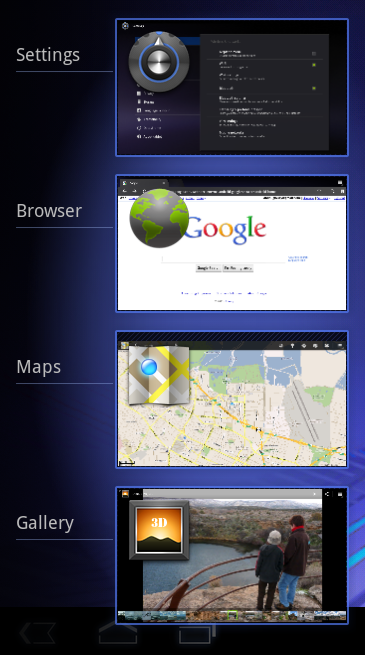
Hey, multitasking isn't going anywhere. And we're getting a new way to switch from one app to another. There will be a "Recent Apps" list tucked into the System Bar. The list will show you a thumbnail of the app -- in the state that you last left the app.
Yes. This sounds very much like desktop computing to us, too.
A new keyboard
Makes sense. As anyone who's used the Samsung Galaxy Tab or some other Android tablet can attest, simply scaling up a current keyboard doesn't really get the job done.
Third-party keyboards are coming, too, as we know Swiftkey already has one in the works.
Revamped cut/copy/paste
This looks a lot like what we've got in Gingerbread, actually. Though going by a screen shot hardly will do it justice. After you've selected text, you can choose an action from the (you guessed it) Action Bar.
New Google apps
We're getting reworked "standard apps" (often called Google apps or Gapps) in Honeycomb.
Web browser
The browser switches to tabbed browsing instead of windows. There's also an "incognito" mode (borrowing from Chrome). You can automatically sign into Google sites, and sync bookmarks with Google Chrome on your desktop.
Multitouch support has been enabled for JavaScript and other plugins. That means a plugin -- say Adobe Flash -- can now detect more than one finger on the screen. Snazzy. There also are improvements for when you're viewing a non-mobile site.
Camera and photo gallery
The camera app has been redesigned for larger screen sizes. You get quicker access to settings such as zoom, focus, flash, exposure, etc. Frankly, those are improvements that we should have in Android 2.2. Let's hope that gets ported over post haste.
Contacts
A big change from Android 2.x to Honeycomb is the use of multiple panes on a single screen. Whereas you'd see a contact list, choose a contact and then have that contact fill the entire phone screen, it'll now do so on multiple panes. (Google's also called these "fragments.")
E-mail/gmail
The stock e-mail app is getting quite the makeover. And we presume the gmail app (which you see here) gets it, too. Like contacts, it'll take advantage of the dual-pane UI. You'll also be able to select multiple messages and act on them, tell attachments to sync at a later time, or use an e-mail widget.
And -- this is our favorite -- you'll be able to drag and drop items, like you see in the image above. That's new in the Android 3.0 framework and can be used in various apps.
Other improvements
High-performance graphics
What's on the screen is just as important as the technology driving it. And in Android 3.0, the graphics get a major boost. Open GL hardware acceleration has arrived for 2D graphics. And for 3D graphics, there's a special renderscript that serves as an API for 3D scenes, as well as a universal shader language. That's nerdspeak for "It'll look good and be fast."
Multicore processor support
This is a big one, as dual-core processors have finally arrived. But, strangely enough, Android hasn't had true support for them until Honeycomb. And Google says that applications that are only written to take advantage of one core still can benefit from the change.
Bigger and better widgets
Widgets are getting bigger and better. You can flip through 3D stacks, have grids or lists. You can also interact with widgets in new ways, including scrolling and flipping the items within a widget.
Multimedia and connectivity
Nerdy, but important. There's new HTTP live streaming, meaning you can feed Android an M3U playlist URL and it'll know what to do with it. Most important, it means you'll possibly be able to watch Apple keynotes now. :p
There's also a new DRM -- digital rights management -- framework. That's the thing you hear about when the record labels and other publishers accuse you of stealing their work.
There also are new stereo Bluetooth profiles, so apps will be able to better interact with your accessories.
New enterprise support
This has been a big headache for a lot of you, we know. We'll just crip from Google here and tell you that "developers of device administration applications can support new types of policies, including policies for encrypted storage, password expiration, password history, and password complex characters required."
Older phones, and older apps
The good news: Android 3.0 is fully compatible with current Android applications. That's not to say you won't see updates for Honeycomb, but your favorite app should at least be functional even if the dev doesn't touch it.
But like we said at the outset: We'd be real surprised at this point if anything but the most recently announced smartphone gets updated to Honeycomb. In fact, we'd go so far to say that a dual-core developer phone might not be out of the question in the next six months. (Boy, we've got our fingers crossed for that.)
More's in store
So those are the broad strokes of Android 3.0. The APIs could still change. Features may be added or removed. We'll updated this post as necessary. But in the meantime, sit back, relax, and enjoy the preview Google gave us at the beginning of January.
Sony Ericsson has been rather forthcoming when it comes to the Sony Ericsson Xperia Arc since it received its official announcement. They've given up close and personal looks at the camera improvements and have given us plenty of videos to watch as well. Interest in this device is starting to rise, especially after Sony Ericsson stated they are committed to the Android platform, maybe that's why we're seeing lots of camera and video samples. Speaking of which, a new batch has now turned up on YouTube and Flickr. Hit the break to see what we're talking about and shout out to Mikael for sending these into us. Also, be sure to check out our own hands-on. [XBlog]