We had been hearing all day from a variety of sources that February 21 had popped up as a possibility for the HTC Thunderbolt to hit stores and then this screenshot from a Best Buy system appeared up over at Android Forums adding to that idea. At this point, I almost don’t care anymore and seriously cringe every time a screenshot like this pops up, but also don’t want you guys to be surprised if one of these dates ends up sticking.
We’re continuing to stand by our original date of February 24th, although you have to admit that launching both the TBolt and XOOM on that day seems like a little much. Again, this is just silly talk at this point and we should know some time this week…maybe.
We had been hearing all day from a variety of sources that February 21 had popped up as a possibility for the HTC Thunderbolt to hit stores and then this screenshot from a Best Buy system appeared up over at Android Forums adding to that idea. At this point, I almost don’t care anymore and seriously cringe every time a screenshot like this pops up, but also don’t want you guys to be surprised if one of these dates ends up sticking.
We’re continuing to stand by our original date of February 24th, although you have to admit that launching both the TBolt and XOOM on that day seems like a little much. Again, this is just silly talk at this point and we should know some time this week…maybe.
The words “Motorola DROID X Old Version” are now appearing online in Verizon accounts across the country, leaving many of you wondering if this could have something to do with the DROID X2‘s imminent release. Sorry folks, but I think it actually has something to do with that pricing change from yesterday. If you happened to return to our post about the DX’s price drop to $149, you might have noticed an “Update 2″ which talks about a change from the 16GB SD card that original adopters enjoyed to the measly 2GB card that is now included. Normally when a significant change like this happens to a device, a brand new SKU is introduced to inventory systems which we’re thinking has prompted the distinction for “old version” and new version. Of course, I could be totally wrong and this could have something to do with the DX2, but I’m sort of doubting it. Cheers Evan and zepfloyd!
We were hoping that right after HTC’s event at MWC late last night, Verizon would have dropped some Thunderbolt news on us, but instead we were left with a device called the Incredible S that may be the Incredible 2. The name “Incredible” and the contoured back obviously lead us to believe that this could be one of our next DROID family members, but the fact that it was only announced for Europe and Asia at this time has us holding back a little. The specs do match up to what we’ve been told previously with the 4″ screen, single-core 1GHz processor, and same 8MP camera, so it’s got to be our guy, right?
The device will run 2.2 when it launches, but HTC is assuring everyone that it will see Gingerbread immediately after. From the picture, you can see that it also appears to be running the new HTC Sense 2.1 which has some really nice improvements even over the 2.0 that will come on the TBolt. It has a front facing camera, 768MB of RAM and is definitely just a 3G device. Note: Let’s hope I’m wrong on this, but I have this really bad feeling that all non-4G LTE phones on Verizon will be stripped of their front-facing cameras. Hopefully this one sticks in the U.S. version, but the DROID X2 not having one is a bad sign. And if I am wrong, then what the hell is Moto thinking by leaving one out? Phone overview and specs.
Thoughts?
The Carphone Warehouse has announced that it's obtained exclusive rights to sell the new HTC Incredible S in the UK, while its North American partner Best Buy will ship the device in the US. The phone is set to launch in both countries sometime next month.
In Europe, the Incredible S will replace the Desire HD as HTC's flagship phone. In the US, it'll ship alongside the very similar Thunderbolt 4G and Inspire 4G. According to HTC, the Incredible S will run Android 2.2 out of the box, but will receive an update to version 2.4 shortly after launch.
Last year Best Buy and Carphone agreed a similar deal with Google for the Nexus S, which gave them exclusive rights to sell the device after its launch last December.
Yesterday we got the chance to play with the Incredible S at MWC in Barcelona. Check out our hands-on feature to find out what we thought. [Carphone Warehouse]
Confused about the dual-core, dual-channel, dual-memory technology that LG's been plugging in its new Optimus 3D? The manufacturer has created a new video to explain what it's all about, with the help of a simple analogy involving factories and conveyor belts. Put simply, the more factories you have, the faster you can create stuff, and the more conveyors you have the quicker you can get your stuff where it's meant to go.
There's also a run-down of some of the major features of the phone, which is expected to launch in the second quarter of the year.
Check out the video after the jump, and be sure to take a look at our Optimus 3D hands-on feature from MWC when you're done.
We've used the Motorola Xoom Android Honeycomb tablet on a number of occasions now, but never the silver one. Let's walk you through the differences:
It's silver. And it's expected to be the non-Verizon version that'll be available whenever it's available.
We also played around a bit with the Speaker HD Dock for the Xoom. The 10.1-inch tablet pugs into it horizontally and can play music over the speaker. And there's an HDMI port in the back for HD output. Thus the Speaker HD Dock, we imagine. Pics are after the break.
We're all still wrapping our heads around dual-core processors. So it only makes sense that Nvidia decided to drop the next next generation mobile processor on us at Mobile World Congress. Codenamed Kal-El (yeah, like Super Man), we're now ushering in the era (on the technical side, anyway) of quad-core mobile processors.
What you'll see in the demo after the break is not Tegra 3 -- it's a hot-off-the-press processor that's more powerful than anything you've held in your hand and that Nvidia says gets a 5x performance boost over Tegra 2. On top of that, it's got a 12-core graphics processor built in, with support for stereo 3D.
And on top of that is the capability to output video at a mind-blowing 2560x1600 resolution -- basically hotter than the sun, or something like that.
Effect on battery life -- it's really better to call it "power consumption" at this early stage -- well, Nvidia constantly stresses it's one of its main concerns. And, again, you have to remember that multiple cores doesn't mean an exponential increase in power consumption. And besides, we'll worry about that once it's in consumer facing devices.
So when will we see these quad-core chips in something we can buy? Nvidia tells us tablets around August, and phones by the end of the year. Yes, that soon.
Check out our demo after the break. You might want to sit down first.
For the many folks running nightly builds of CyanogenMod 7 you'll want to hit ROM Manager or the CyanogenMod forums if you haven't already. V7.0.0-RC1 is now available for download if you're using either a Nexus One, MyTouch 4G or HTC EVO 4G. If you're not seeing it as of yet, just hold out a little bit longer as things are likely still populating across servers. Don't forget, if you happen to run into issues you can hit our forums for some help as well. [CyanogenMod] Thanks, everyone that sent this in!
The Motorola Droid X has just seen an across the board price drop, ranging from $149.99 (with a 2 year agreement) at Verizon's website, to a whopping $9.99 (see above) with a two year plan at Costco. A big player in the price reduction may be the fact that Motorola has decreased the internal memory from 16 GB to 2 GB. Or maybe it has something to do with the Droid X2 leak that came and went and the X is reaching the end of its short life.
In any case, if you've been eyeing one, now would be a good time to grab it before its too late, and maybe you'll get lucky and find one on the shelf that still has the 16 GB of memory. [Android Central forums] Thanks anon and everyone who sent this one in!
Taking under consideration the customer support page showing how exactly to install the update has had some changes made to it today, it seems as though the roll-out of the Froyo EB13 update for the Sprint Epic 4G is imminent. Although we've not heard anything even remotely official from Samsung or Sprint as of yet, we'll be keeping an eye out to see if they start pushing it out to users. If you happen to see the update pop-up on your device, be sure to let us know as well won't you? [Sprint] Thanks, Daryel!
Live here at Mobile World Congress, we just got word from Eric Schmidt that the next version of Android will combine the feature set of Honeycomb and Gingerbread. Schmidt didn't give any details on naming (we've heard both Ice Cream and Ice Cream Sandwhich), but it'll definitely be the "I" version of Android. Looks like some of our favorite Honeycomb features will be making their way to phones.
HTC has confirmed via Twitter that its new Incredible S will run Android 2.2 out of the box, but will receive an update to version 2.4 shortly after launch. The Desire S and Wildfire S, however, will run 2.4 when they're released. HTC has also committed to a Honeycomb update for the Flyer in Q2.
This discrepancy is most likely down to release timing -- the Incredible S launches next month, whereas the Desire S and Wildfire S are slated for release during the second quarter of the year.
To find out more about HTC's new toys, check out our hands-on coverage of the Incredible S and Wildfire S from today's HTC Mobile World Congress event. [HTC on Twitter]
Remember when 1GHz processors were the real deal? Yeah, within the past year. Remember when Dual Core processors like the Tegra 2 were cutting edge and powering the hottest handsets and tablets? Yeah, that’s still cutting edge and the first dual core smartphones and tablets are still being announced. So then what NVIDIA showed us today at MWC – a Quad Core Android Tablet – could be the sharpest edge of all.
Tegra 2 is just now getting out of the gate and we’re already looking ahead to Quad Core Android tablets in August and Quad Core Android phones in November/December thanks to NVIDIA’s products. You can look at lots of different benchmarks and comparisons, but processor details often go over the head of even the tech savvy. Here is what you need to know:
NVIDIA’s Quad Core already enjoys 5X better performance than current Tegra 2 (Dual Core) processors
Tegra 2 is multiple times more efficient than single core processors, meaning Quad Core is exponentially better than processors in most of the hottest Android handsets currently on the market
Because power consumption is split across 4 cores and 1 core isn’t overworked with lots of heavy lifting, each core is more often in a “resting” or “relaxed” state which exerts less energy. Bottom line? Longer battery life.
Everything you do on your phone – web browsing, video watching, game playing, multi-tasking and beyond – will have improved speed and clarity with Quad Core
Two big name manufacturers are already on board and testing Quad Core while NVIDIA also works with game developers to optimize performance. In the game shown in the video, they were able to cram 620 more soldiers onto the battlefield, taking the experience from a gaming like atmosphere to a realistic warrior melee.
Because of NVIDIA’s deep roots in gaming, they’re working closely with game developers who can provide improved experiences specifically with Dual-Core and Quad-Core solutions. We’ve seen Alpha versions of “TegraZone” which highlight these games, many of which have extra levels and added features in addition to improved performance, and we’re expecting Tegra Zone to launch (in beta) in the coming weeks. NVIDIA’s head start is notable- Qualcomm won’t be bringing Quad Core to market until 2012 and if there’s anything we know about the Android world, it’s that manufacturers and carriers want their high-end smart phones packed with the latest and greatest specs. There are too many competitive products – if you try to skimp on the high-end you’ll be DOA. Case and point? The HTC Flyer with a single core processor and Android 2.x. I expect the XOOM, Galaxy Tab 10.1 and Optimus Pad to blow the Flyer out of the water (or shoot it out of the air?) even after and if it gets Android 3.0.
The folks at NVIDIA are really pushing dual and quad core to their partners and rightfully so. I asked them what percentage of new Android devices would be running single vs. dual vs. quad core by the end of the year or in 2012 but it’s nothing they can predict. Why? Because although they believe multiple cores are almost always better, they can’t force them upon partners (again, the HTC Flyer is a prime example).
Don’t forget that high-end Android phones aren’t the only show in town. It’s perfectly possible that new launches of mid-range devices purposefully keep their processors lower-powered for the sake affordability. But want to know why I’m most excited? Because the bar for what’s considered “Mid-Range” for Android Phones is continually rising. While the most awesome Android Phones were powered by 1GHz processors 1 year ago, Quad Core will be powering the most awesome Android phones 1 year from now. When that happens, those buying Android phones on the lower-end will likely be rocking around 1GHz single core if not some sort of dual core to promote efficiency/battery.
Essentially, yesterday’s Top of the line Android phones will be tomorrow’s mid-range entry-level smartphone, thanks much in part to the breakneck speeds at which NVIDIA is improving processors.
Of course there are two sides to every story and one huge negative comes out of all of this: do you want to splurge for a cutting edge Android device now when you know Quad Core is on the way this year? That’s the unfortunate dilemma of a gadget geek, new things are ALWAYS on the horizon and you ALWAYS want what’s new. You could blame it on NVIDIA, but I think you’d better not… we all want them to continue what they’re doing. It’s only February but it’s already time to start writing your list for Santa.
Folks have spotted a change on Sprint’s support site that shows folks exactly how to install the new EB13 Froyo build for the Samsung EPIC 4G Sprint was one of the carriers who were apologetic regarding the delays and wanted to get the firmware out as soon as possible. That’s about as far as this story goes, though, as that support page has since been stripped of all that made it interesting. If this is the real deal, Sprint could be ready to launch as early as next week. Let us know if that happens, will ya? [via Android Forums] [Update]: Click over to this post on Android Forums if you want to see what the page said. (Without all the pretty graphics, of course.)
Immediately following HTC’s announcements yesterday, carriers wanted to express their plans to carry one or more of the devices. Here’s a quick round-up of everything we’ve heard and seen so far.
AT&T’s told Mobilized that they’ll be carrying two phones from HTC similar to the ChaCha and Salsa, the “Facebook phones”.
Telus is going to have the HTC Flyer in Canada within a few months, according to sources of Mobile Syrup’s.
One question many had regarding the Sony Ericsson Xperia Play’s ability to play classic Playstation One titles was whether or not you’d be able to transfer PSN content that you already own. The answer, unfortunately, is no: if you own a game on the Playstation 3 or PSP that is also available for Xperia Play, you’ll need to redownload it.
The word comes in from GameSpot who spoke to Sony Ericsson’s Nathan Vautier. There’s a good chance that things could change, but there’s still a good chance that they won’t. If this doesn’t bother you – great! But I can’t imagine those who have invested a lot of money in Playstation classics on the PSN will be joyed to know that they’ll have to start all over again if they want them on this phone.
Here we go again: according to sources who spoke to Greg at MobileCrunch, Google is preparing to roll out the Nexus One OTA upgrade either late this week or early next week. I have not heard this myself so I can’t confirm or deny, but if several independent sources said the same thing, then I think it’s safe to bet big on it being true. Be on the lookout and give us a holler if you do end up getting it soon.
Eric Schmidt has just announced that Android has reached 350,000 activations each day. After doing some dirty and quick math, that comes out to about 10 million per month. And in a year? 127,750,000. That number is huge, isn’t it?
And it’s expected to keep growing throughout 2011 and beyond. Android is projected to surpass Symbian – the world’s top smartphone and mobile OS – in 2014. The first milestone was reached in Q4 2010 where Android was the single biggest smartphone OS throughout all the land.
OEMs rely on Android to provide unique products that set themselves apart from their competitors, and that’s one big reason for its growth. That’s probably the single biggest reason for its growth, really.
After Microsoft failed to innovate quickly enough (we didn’t see a next generation OS release until 2010), OEMs jumped ship to Android as Apple had introduced a new phone that would change the face of the industry. And all of those OEMs had no way to catch on as they hadn’t anticipated such a swift change.
But Android was already in the works – long before the iPhone was announced, actually – and it has been moving toward being the standard alternative since 2007. It got off to a very slow start in 2008, but just two years later it’s the fastest growing operating system ever.
The scary part is that it’s nowhere near over. Android will hold its reign for years to come, and you know we’re not mad about it. (Well, maybe a little. We’re sure we’ll have to work a lot harder in the future.) But we aren’t complaining. I’m bringing back a throwback phrase with this one: Go, Android, go!
We’re sitting in live at Eric Schmidt’s keynote here at Mobile World Congress, and one of his first talking points was that Android market now has 150,000 apps in the market – it was somewhere around 50,000 just 9 months ago.
AppBrain released some early numbers based on their own statistic they keep back in late December, and the number looked a lot better as they’d estimated over 200,000. That may not be the case today, but 150,000 is still something to be proud of, I think.
Android has gained a lot of popularity with developers starting in 2010, the year that Android skyrocketed right past most of its competition.
Countless surveys and studies have been done that show developers are indifferent when it comes to developing for iPhone or Android, and nearly half of all developers actually prefer dealing with Android – everything from the flexibility in development to the freedom of the market.
And countless industry reports help developers reassure themselves in their plans to focus on Android just as much as they focus on iOS. Android became the world’s top selling platform in Q4 2010, beating the “king” Symbian, and they’re expected to be number one in market share in 2014.
Developers see just how many people are clinging to Android. The strategy Google’s employed doesn’t matter to us in this story, but the end result of that strategy shows them that there is finally real money to be had here.
2011 will only be greater as we see an entirely different Android market take off – one that’ll be geared for Honeycomb-based tablets. And the phone side of things will only keep growing.
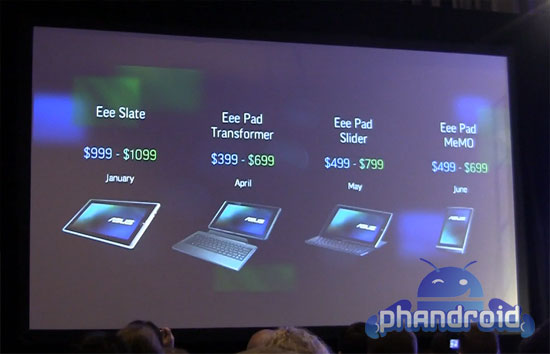
Acer first announced their Eee Pad Slide, Transformer, and MeMO at CES but we got the opportunity to test them out for the first time at MWC. Video footage was not allowed since the units aren’t finalized, so all I managed to snag were still pics, but I’m pretty interested in what ASUS brings to the table.
The ASUS Eee Pad Slide is the one I personally found most interesting. It’s super slim when closed but you can slide it open to reveal a FULL QWERTY keyboard:
I love the idea but ASUS definitely needs to improve the slide mechanism – it’s a bit rigid and forced when opening/closing but if they could make it a bit smoother it would be really nice. I was pretty amazed how slim the keyboard portion remains, meaning when it’s closed and you’re not using the keyboard you don’t sacrifice much portability. With the slider closed it’s still a pretty strong device in and of itself.
As usual, Tegra 2 and Honeycomb is looking like a pretty good combination. The device looks even better when you have a beautiful young lady and company rep modeling it:
Another tablet with keyboard combo ASUS has coming out is called the ASUS Eee Transformer:
Instead of merging tablet and keyboard with a must-use mechanism, ASUS allows you to completely detach them from eachother with the flick of a switch.
The tablet functions fully on its own so you can easily leave the keyboard behind and bring the tablet along for travel.
Some of the Transform specs:
Tegra 2 and Honeycomb again? Yes please!
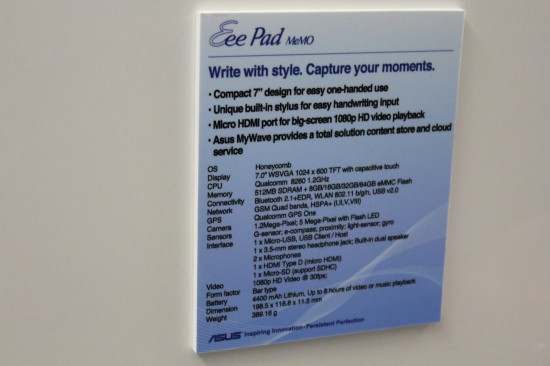
Lastly we’ve got the ASUS Eee Pad MeMO which is a slate with stylus.
I wasn’t personally intrigued with this device because it’s a bit small for my liking and I don’t personally have a need for a stylus. Then again, there are many other people who prefer a pocketable tablet and who desire a stylus- these folks could definitely end up loving the MeMO.
Yet again we’re looking at Honeycomb but this time on a Qualcomm 8280 1.2GHz processor. I would have preferred the dual core NVIDIA solution and I’m thinking that the smooth fluidity of UI would have gone a long way when using a stylus. Handwriting is a utility where you don’t want any jerkiness.
Neither of these devices was actually running Honeycomb in their current form… which is why they didn’t let us film it. These devices should be launching in April, May and June respectively so stay tuned!
Judging by the HTC Flyer and its lack of Android 3.0 at launch, we can’t say for sure when the new OS will officially make its way to an HTC device. But why does that matter when it’s already on the HTC EVO 4G So what if it doesn’t really function as a usable OS, at least we can get an idea of what the marriage of beautiful hardware and software could really look like.
This one is still pretty buggy and lacking in a lot of functionality that makes it worth keeping on your phone, but if you have the means and knowledge and want to get an inside peak at what is coming in the next release of Android here is your shot. We absolutely love Honeycomb and have had a blast checking it out on a bunch of devices over the past week at Mobile World Congress. Follow the source link for more instructions.
Alcatel’s looking to bring affordable Android devices to Europe with their OneTouch series. We stopped by their humble abode here at Mobile World Congress just to see what type of value they provide for their customers. There were three phones on hand starting with the OneTouch 990.
Alcatel calls this their flagship Android handset. It has a 3.5 inch capacitive display, Android 2.2, a 5 megapixel camera, a 600MHz Qualcomm MSM7227 processor, and Alcatel’s custom user interface on top. It’s going to cost about 180 Euros off contract when it finally does come out sometime in Q2.
I was a bit underwhelmed by what was supposed to be their flagship. The software ran incredibly slow, moving around the homescreen was difficult, and the display made everything look uglier than it probably was. The phone is still considered a prototype, however, as it still has a few months to go before it’s ready for prime time.
They had two other phones – the 908 and the 890 – which are considered their lower-teir phones. The funny thing is that they ran a lot smoother than the 990, though they both have slower processors. (We weren’t able to determine which architecture it was, however.) The 890 is an interesting device, though, in that it doesn’t have a capacitive display. It also has no 3G radios.
We’re told they felt people who were going to use this phone wouldn’t need to use 3G data, so they elected to exclude it to keep costs down. This device also had physical call end and send buttons and a 2 megapixel camera. It’ll launch with Android 2.1 but she said there was no word on if it’d ever be upgraded.
The 908 was a bit better – it had the same display size as the 890, but it uses capacitive technology. It also excludes call end and send buttons, and it has Android 2.2 out of the box. And unlike the 890, the 908 will include quad-band 3G radios. And it also has the same processor.
They were rather uninspiring, but for the market they’re aiming for they’ll have to do. The 990 will cost 180 euros, the 908 will cost 130 euros, and the 890 will be 99 euros once they’re all out sometime before summer.
None of these devices will blow you away but they’re the type of offering I’d suggest to a first time smartphone user who doesn’t want to be bothered with the Android learning curve and a huge piece of hardware in their pocket. Want an introductory Android that does a lot more than your current phone and the ability to do so much more if you’re up for learning? The Mini, Fit, Gio, or Ace could be your next phone.
The Galaxy Mini reminded me a lot of the HTC Wildfire S announced yesterday. They’re both new iterations of successful phones but I thought they looked alike, too. Comparing them side by side I notice less of a difference, but both reminded me of smaller, dumbed down versions of the Nexus One
We’re always eager to see the next age of elite phones but don’t forget there is a massive number of non-smartphone users the manufacturers would love to convert. Maybe the Galaxy Mini, Fit, Gio and Ace will help accomplish that task.
T-Mobile USA will launch the Galaxy Mini in the Spring for $50 to $75 on a 2-year contract.
We’ve finally got ourselves some preliminary pricing information for the HTC Flyer tablet introduced yesterday at Mobile World Congress. Amazon Germany has revealed a 670 Euro price point – that’s just over USD $900.
Many were hoping to see it a bit cheaper than several of the Honeycomb tablets coming out as they see this as HTC’s Galaxy Tab. The reality is that we’re still not sure if the price is justified or not because we haven’t seen enough of the tablet.
Amazon didn’t include a date to go along with their little reveal, but HTC told us this thing should be out within a month’s time. It’ll be interesting to see how carriers will price this if they allow subscribers to subsidize the cost. Let’s hope any subsidy puts it right around the Galaxy S’s average price point ($400-$500) when it debuted. [via TabletGuys, Thanks Denny!]
In a world of 10-inch dual-core Androids, HTC has opted to tread its own path by cranking up processor speeds, sticking to a 7-inch form factor and eschewing the latest Honeycomb build for a Gingerbread version it could customize more comprehensively with Sense. All that's well and good, but sometimes all it comes down to is how these gadgets look and feel. So to help you wrap your mind around the Flyer's new aluminum body, we present a couple of comparison galleries with it set against two devices that need no introduction. Get clicking!
We've been hearing rumors of a Motorola Droid X 2 for a few days now from The Mobi Zone, complete with specs and pictures (above). Supposedly, it's the successor to the Droid X, with a similar appearance, Android 2.2 with MOTOBLUR, and the same 8 megapixel camera. Some of the leaked specs -- 4.3-inch qHD (960 x 540) display, 1GHz Tegra 2 dual-core CPU, 1GB RAM -- didn't sit well with us, since these closely match the upcoming LTE-equipped Droid Bionic. We did some digging around and one of our trusted sources confirmed that the Droid X 2 aka Droid X "squared" is indeed coming to Verizon in Q2 2011 without LTE. However, it appears to be a refreshed Droid X, with the same 4.3-inch WVGA (854 x 480) display, a 1.2GHz single-core CPU, and 768MB of RAM. It's not quite the powerhouse it was originally made out to be, but it now seems to be a better fit in the Droid family.
Putting Pathpartner and Ittiam right beside one another may not have been the best idea if these two were hot-headed, but shockingly, they were treating each other with a great deal of respect within Texas Instruments' MWC booth. All jesting aside, the former's 720p HD videocalling solution is aimed at an entirely different market than that of the latter. Rather than arranging for a four-way video conference, Pathpartner has concocted an Android app that enables 720p video calling over Skype -- you know, that VoIP application that you're already obsessed with. Currently, the company's working with Skype in hopes of getting it 'Skype-certified,' and like Ittiam, it's also chatting with a number of handset makers in hopes of getting it embedded on the phone's software stack from the get-go.
Alexy Mathew Joseph, the company's senior technical lead, was on hand to showcase a demo running on a pair of OMAP 4-based development boxes, and the low-bitrate technology that he has helped create enabled smooth, high-def streaming of the call. We should mention that this particular demo was done over an Ethernet network, but he affirmed that it would operate on 3G and 4G networks as well. Also of note, the new software is capable on running on more than just TI equipment, though he wouldn't elaborate other than saying that NVIDIA's Tegra 2 was a platform he hasn't tested on just yet. Just think -- 720p Skype videocalls could be hitting your phone prior to the dawn of 2012, and the carrier's have to be weeping at the mere mention. Vid's past the break, per usual.